Monday, 23 June 2008

Mobile payment systems in Malaysia: its potentials and consumers’ adaptation strategies:

There are many electronic payment methods, which includes electronic payment cards. Virtual credit cards, smart cards, person-to-person payment methods, payments made electronically at kiosk, and many more. E-payments for business-to-business include electronic checks, purchasing cards, EBT, EFT and many more.

The mobile channel can be effectively used as a self-funding and revenue generating medium.

In Malaysia, these services are developed at a very fast rate. Its has been increasing rapidly and improving day by day. In fact, its popularity can be viewed through the bar chat.

There are some characteristics that makes it so Famous. Besides being an independence device, its divisible, safe and has little transaction fees. It is easy to use and has certain regulations that make it very reliable.


Malaysians have made various improvement and changes to adapt and use e-payment systems. Companies have changed to a computerized era and have upgraded their own knowledge on IT. To support such a system, they have to make sure it is easy and simple for their customers to use. Besides being user-friendly, there are customer service departments to assist users who are illiterate in IT to use such a system too. Companies have made use of the internet to help improve their own efficiency and also customers’ convenience.


Education has played a part too. Children of this generation rely highly on the internet. They used it everyday to send e-mails, finding information and even keep in touch through many applications online.

E-payment has become an essential part of our lives today, making it very easy and convenient. Thanks to the IT development, we can save the hustle and bustle on the road and paper work, being more environmental friendly.

by Liew Yilin

Wednesday, 18 June 2008

The threat of online security: How safe is our data?

The Internet should be a safe way to shop. However, security relies on alertness and you should extremely pay attention to safeguard your data when you are online.Online security is an essential issue for all internet users. The threats are always changing so it's important to ensure antispyware and anti-virus software always up to date.

There are several cases that could increases our awareness of importance of the security of data. For example the theft of the laptop which contain of a lots of confidential information can put the record at risk. As a consequences the data could be misused by the other party who with the crime intentions.

Accidental actions that will lead to the threat to our security data include as poor password options or the losing of CD. A poor password choice could encourage cybercriminal take only few second to hack in. The users with lack of knowledge about online security concepts are necessary to be educated to safeguard their data. Otherwise, these threats can result financial loss, legal liabilities, breakdown of duty of care and so on.

The next possibility of exposures of security data are the hacking activity. There are also cases that revealed that even a big organization like hospital or university could be hacked. The loss of the important information such as financial, bank accounts, phone number, salary details and so on. This data can be abused to apply the loans or credit cards.

Therefore it is advisable to have the full alertness towards the maintenance of the confidential information or privacy. Otherwise, exploitation on data by the cybercriminal will bring us only a tragedy.

Reference:

http://www.theregister.co.uk/2007/03/28/hospital_laptop_theft/

http://www.theregister.co.uk/2007/04/04/ucsf_computer_security_alert/

http://www.theregister.co.uk/2008/01/07/lib_dems_data_losses/

by Ngan Sin Yin

Monday, 16 June 2008

Phishing: Examples and its prevention methods.

Phishing is a new type of network attack where the attacker creates a copy of an existing Web page to trick users by using specifically designed e-mails or instant messages into disclosing your private information that will be used for identity theft. Typically, the e-mails come from well known and trustworthy Web sites such as PayPal, eBay, MSN, Yahoo, BestBuy, and America Online. The e-mail directs the user to visit a Web site where users are asked to update their personal information, such as passwords and credit card, social security, and bank account numbers, that the authorized party already has. This practice is sometimes referred to as "fishing" because the attacker is fishing for user private account information. Typically, attackers try to trick user into providing user name and password so that they can gain access to an online account. Once the attacker gains access, they can use the user’s personal information to commit identity theft, charge user credit cards, empty user bank accounts, read user email, and lock user out of the online account by changing user password.

One of the examples is WesBanco Bank, Inc. WesBanco is a multi-state, bank holding company. The headquarters is in Wheeling, West Virginia. Deposit and nondeposit products are available through the WesBanco companies. WesBanco has been phishing attacks in the last few weeks. The prevention that WesBanco do is that they will upgrade the servers to withstand this severe flow of attacks. In addition, they will be implementing additional security features in their online banking service. Due to these upgrades, user may experience interruptions while using WesBanco’s online banking. There is another method that can prevent users from being trick, that is update their WesBanco online banking information by clicking the link below: https://onlinebank.wesbanco.com/update

Another example is PayPal where spelling mistakes occurs in the e-mails and the presence of an IP address in the link(visible in the tooltip under the yellow box) are both clues that this is a phishing attempt. Another difference is the lack of a personal greeting, although the presence of personal details would not be a guarantee of legitimacy. Besides that, other signs show the message is a fraud are misspellings of simple words and the threat of consequences such as account suspension if the users fail to comply to the message's requests. The PayPal prevents these problems by advising the users of PayPal never to provide their password to unknown persons. PayPal will automatically update the users’ confidential details using the Secure Sockets Layer protocol (SSL). PayPal will not ask their users to enter their password in an e-mail as well.

It is our responsibility to be aware and alert for these kind of threats.

by Ng Pei Qi

A Review on a post on Internet Security from My E-commerce blog

According to the blog, I have realized a lot of things on what security is and how important is it to protect ourselves.

For the China’s case, 1 million in 12 months is a lot. viruses, worms, and Trojans being able to reach this scary figure indicates a loud warning sign. Ironically, as long as there are virus an all these in this world, there are antivirus software and others. They seem to come as if they were planned. Adding the calculation made that 1 million out of 130 million which is about 0.77% malwares found in china, this is a scary amount. Added to the disaster, China can fall back in a lot of knowledge and updates in the current world. It is the internet that keeps everything alive!

Malware is another dangerous thing. It is all out to fool anti-virus programs. Which means our anti virus might not be able to detect it. Now, it all happened vastly during year 2007. Question is why? Was it because of the unstable economic condition that made people find means to get money? Or, was it due to some enemy between the countries top military peoples? Or is it due to more and more criminals out there on the loose, getting revenge against whoever they want to? In fact, hi-tech criminals are actually trying to mixed up programs created to detect them.

Many security firms for example, Panda Software, AV Test and f-secure have reported a significant increased in the viruses found online. Which means it is no longer that safe anymore for us to serve the net as we used to in the past. To the extent that even bloggers are being threatened? Like for the joke on the John cow web being hacked? That was a funny yet interesting one, but only to the extent that no harm was caused. Actually, it shows how important it is to prevent and protect our blogs from being hacked. Besides overriding our personal rights and disturbing our private peaceful lives, these hackers are nothing but a bunch of nonsense. Various prevention is recommended and to me, better safe than sorry.

To me, sometimes messages needed to be passed on, or conveyed on to attract people’s attention onto something serious is important. Yes, the method is indeed very important. But, to use such ridiculers and absorb way is a little insensible isn’t it? It misleads others making others having to go through many unnecessary troubles. Maybe US people think differently. According to the comments given, I guess only a hand full are acting and thinking normally.

Indeed fighting cyber terrorism is important, but I personally hope this sum of money spent is not misused again. People want to see results, the outcome for such an amount paid. The serious cyber war that occurred in Estonia is astonishing. No one is hurt, no blood spilt, no killings, no bombing, no nothing. But, the damage is severe. Its such a small place. In fact, not counting in my low geography knowledge, I myself have never heard of this place before! I am also quite certain, cyber war won’t stop. This is merely the beginning of a cold and brutal war.

The best examples for spams are the junk mails we received in our mails. There are so may types of spams. For example, spam in blogs, mobile phone messaging (my 1st encounter) and internet forum spam. The new tactics like PDF spam, Piggyback Spam and greeting card spam are interesting. The innovative hackers or rather spam creators, used various ways to get their spamware into out personal pc. But, it looks like they’re going to have a hard time now since we are all aware of such things.

As for the Pentagon’s case, the US Defense Security really doesn’t use emails? This sounds like a joke to me. Sources of hackers include recreational hackers, self-styled cyber-vigilantes, various groups with nationalistic and ideological agendas, trans-national actors and nation-status.

Now this really attracted my attention. I don’t know if I am being ignorant about what’s going on but, I really have never of mobile malware? It seems even mobile devices can be affected! This is a dangerous indication. It seems as if everything we use, do have might become a threat to our own lives. There are several potential threats and also some prevention too. We should really take not of them.

To me, everyone has their rights to personal life. These stealing indirectly cause people to loose their privacy. Its like, putting an advertisement of your biodata including other information which are private and confidential having the perception that everyone on earth holds a right to your life! No way!! This is too much. Sometimes, for their own benefits, humans are willing to do anything and just everything to get what they want. Now that’s what I call reality. However, since company’s and organizations are holding people’s personal data, regardless of whether is it P & C or not, it is the trust entrusted to them by users. It is only the company’s responsibility to make sure everything is in tip top condition. They should be given the 1st top priority when it comes to security.

Well, what can I say? Competition is everywhere. But, the fact is, dirty works turn me really off. Why can’t people compete fairly? Oh well, nothing’s fair. The only thing that is fair given by God, is 24 hours a day. That’s all. Not even justice and law of the high courts make fair equal judgment sometimes.

To me, these hackers are genius. Like the guy from Singapore? To me, I felt that the government should really make use of these kind of people to really track and hack down hackers. Well, they are one of a kind. It is possible that only an actor will recognize another actor. That’s very true. Remember the show, Catch Me if You Can? Now, that’s the best example.

There are always new treats coming up everyday. And, we can’t stop these things from happening. All we can do is just read and update ourselves to make sure we are at the safe side. That’s the best we can do to stop all these from becoming more famous. Just like, stop the killing by stop the buying.

by Liew Yilin

HOW TO SAFEGUARD OUR PERSONAL AND FINANCIAL DATA?

As Internet criminals grow smarter and sneakier, it's increasingly difficult to keep our personal and financial data safe. If we don't take basic steps to protect our information, we may find ourselves a victim of fraud or identity theft.

To ensure that we don't fall prey to cyber fraud, be sure to follow these top 10 rules to ensure our information safe online:

1. Install a firewall.

A firewall is a software program designed to allow good people in and keep bad people out. Most new computers come with firewalls integrated into their operating systems. Those who have a DSL or cable modem have an added layer of protection because these modems come with yet another firewall built in. If you have an older computer or use dial up, you may need to purchase a firewall separately and install it yourself.

2. Install and update antispyware and antivirus programs.

Microsoft and numerous application vendors offer users regular updates to existing antispyware programs, so be on the lookout. As for antivirus protection, Symantec and Norton antivirus are popular choices.

3. Avoid accessing financial information in public.

Resist logging on to check your bank balance when working from a coffee shop that offers wireless access. These systems are convenient, but also unknown. Casual users have no way of assessing how sturdy their firewalls are.

4. Update your browser.

Updating your browser on a regular basis can help plug up security holes, so make it a habit.

5. Look for "locks."

The Web address should start with "https" instead of "http". Also, look for small lock icon in the lower-right corner of the browser window.

6. Don't open mystery attachments.

Never open an attachment or click on a link sent to you by an unknown party. Attachments can contain viruses and links can lead unsuspecting users to dummy sites where they are asked to input financial information.

7. Don't be paranoid, but be aware.

We don't need to be scared, but we need to be cautious and cognizant that there are people on the Internet that will take advantage if we allow them to. If something doesn't seem right, trust your gut.

8. Be cautious about providing your information.

Don't give your financial information or personally identifying details to organizations you don't know or haven't dealt with before. It's important to know that giving simply personal information such as date of birth and mother's maiden name can be just as dangerous as financial information.

9. Be careful of the merchants with which you deal.

Try to make sure it is a legitimate site; not just a spoof of a real site. Only do business with reputable companies.

10. Keep your eye out for scams.

Many people have become familiar with common scams and delete them without hesitation, but now there are more convincing scam e-mails. If you receive an e-mail from any institution asking for your personal or financial information, even if it appears to come from a place you trust such as eBay or Bank of America, do not respond. Instead, pick up the phone and call to verify that information if necessary.

by Leong Yen Teng

Thursday, 12 June 2008

An example of an E-commerce failure and its causes

In a situation where you are teaching people to learn about a subject, it is always helpful to discuss examples of activities (or companies) that are successful since this can be a way to bring out the important points of what you need to do to be successful.

On the opposite side, it is also considered to discuss examples of activities (or companies) that are NOT successful or in other words-failure, since this can be a way to show how to avoid the mistakes others made.

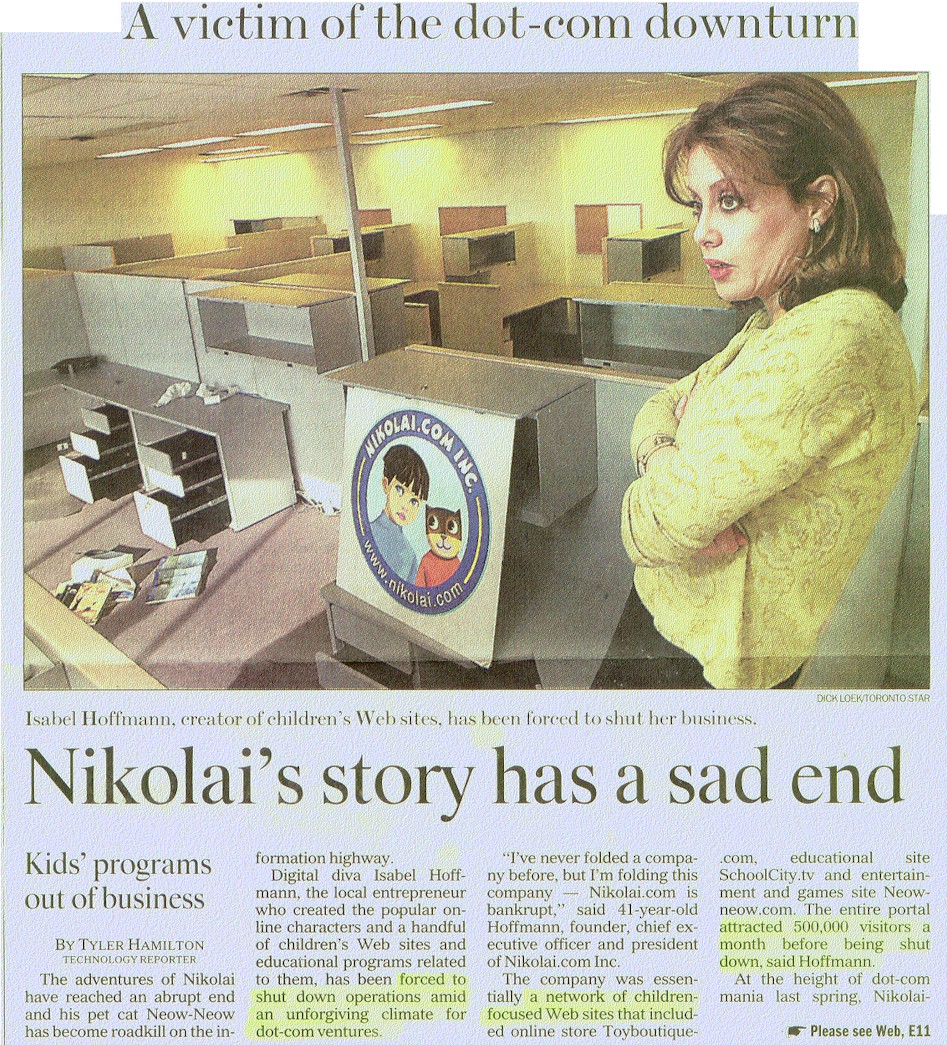
Therefore we will discuss these dot.com failures for the purpose of learning how they made "serious" mistakes. Dot.com failures have become so common in 2001 and 2002 that there are a number of websites devoted to listing them and listing links to media sites that carry that story. One of the examples of dot.com failures is Nikolai.com.

The company was formed by a 41 year old women name Isabel Hoffman. She is also the founder, chief executive officer and president of Nikolai.com. The company was a network of children focused web sites that included an online store Toyboutique.com, educational site and entertainment. It had attracted 500,000 visitors a month before shutting down.

Isabel Hoffman, creator of the children websites, has been forced to shut her business because on the day the site was formed, the founder, Isabel Hoffman, posted a bit of a rant about how people don't care about their children and etc. Her main point is that she (an independent content creator) could not get the big buyers to buy into her plans. Therefore she had no "buyer" for what she was producing.

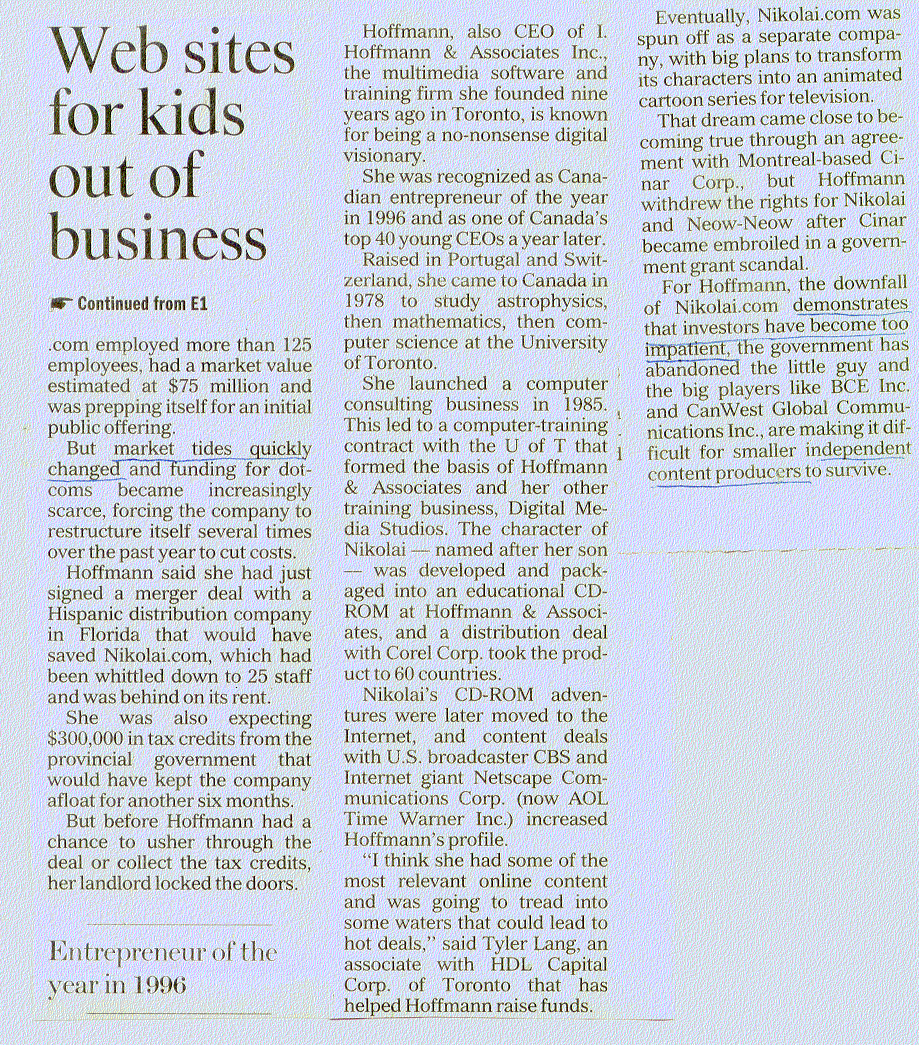
Another factor that contributed to the failure of Nikolai.com is that the company was facing financial problem. The company had a market value of $75 million and employed more than 125 employees and was offering themselves for an initial public offering. However, the market changes very quickly and financial support for dot com became increasingly insufficient and the company was forced to restructure itself for several times over the past few years to cut costs. The company is also expecting $300,000 in tax credits from the local government that would keep the company floating for another 6 months.

You may click on the website and read more story about why the company failed.

1. http://www.witiger.com/ecommerce/nikolai1b.jpg

2. http://www.witiger.com/ecommerce/nikolai2.gif


Monday, 9 June 2008

The history and evolution of E-commerce


Before the birth of the famous internet, back in the archaic days of the Arpanet, e-commerce began their impact on the way a business is run. The history of this vast improving system is how information technology has transformed business processes into how it is today.

The best and simplest example would be shopping, which I am sure is a popular mode for relaxing and could be done anytime, anywhere, even in your pajamas! Now this brings us back to the invention of the very old notion of ‘buy and sell’ electricity, cables, computers, modems and the internet of course! Started in 1991, it was made possible to do shopping online and since then, hundreds and thousands of businesses started to venture into this promising approach-the E-commerce.

Now, before I continue, let us define what e-commerce is. E-commerce is a process of the execution of commercial transactions electronically with the help of the leading technologies like Electronic Data Interchange (EDI) and Electronic Funds Transfer (EFT) which gave an opportunity for users to exchange business information and do electronic transactions. It was founded in the late 1970s and the ability to use technologies appeared.

During 1994 e-commerce started to become popular. It took four years for it to develop the security protocols and DSL which allowed rapid access and connection to the internet. During the 2000s, e-commerce changed the process of purchasing of available goods and services over the internet using secure connections and electronic payment services. Even when the dot-com collapse in year 200 did not stop people from using e-commerce. ‘Brick and mortar’ retailers recognize the advantages of electronic commerce and started to add such capabilities to their websites. At the end of 2001, the largest form of e-commerce, the B2B made $70billion in transactions. The chart shows in 2007, e-commerce sales amount to 3.4% of the total sales.

We can’t run away from sires like Amazon.com and Ebay when talking bout e-commerce. They are one of the 1st few internet companies to allow electronic transactions and succeed. The 5 largest and most famous world wide internet retailers are Amazon, Dell, Staples, Office Depot and Hewlett Packard. Fortune magazine, 2007 stated that dell as the 34th largest company in the Fortune 500 list and 8th on its annual top 20 list of the most successful and admired companies in USA.

Lastly, ecommerce is a history of a new, virtual world which is evolving according to the customers’ advantage. The evolution of this will never end. As long as technology breaths in the air, it will continue improving for the better. E-commerce has come a long way, evolving from organizations billboards to a fully functional personalized shopping experience. Although the road was bumpy from 1994-2004, it has now become a crucial part of Internet pioneers and technology innovators.

Rich Riley once said, “specifically, and important milestone in the evolution of e-commerce is the development of affordable, easy-to-use e-commerce solutions that have enabled hundreds of thousands of entrepreneurs to transform their unique ideas into organizations successful business.”

Some examples of some evolutions are like, in Abu Dhabi, police have installed a number of automated machines in different shopping mails of the city owing to which some electronic services become available. The network got the name Sahei (facile) and is known as e-service and payment system. There are other examples found in www.ecommerce_journal.com/

In conclusion, e-commerce today is still at its infancy. Invisible shopping carts, annoyance-free assistance and no lines at the register and many more benefits awaits the future of e-commerce. There is a bright future for it. Besides narrowcasting, there are also services like new quantum processors that will increase the speed of computers twice as fast and HDTV’s popularity allows us to surf and shop on their television sets.


by Liew yilin